Originally Published May 8, 2015
By Sheena Faherty, Organizing Committee Member of ComSciCon-Triangle 2015
This year, the national ComSciCon workshop received about 1,000 applications from grad students around the country—and only 50 spots for lucky science communicators.
Clearly, graduate students are voracious for training in science communication skills.
This prompted the national ComSciCon organizers to put out a call for action: “Fellow grad students, I implore you! Organize a local ComSciCon workshop in your area.”
The first of these local workshops was held in the Triangle area of North Carolina in March of 2015. Organized by six grad students from UNC-Chapel Hill, NC State, and Duke, the workshop served 50 graduate students from those schools in all areas of STEM fields. Spearheaded by Rosa Li, Duke Psychology & Neuroscience PhD student, the organizing committee invited many brilliant and engaging science communication experts from our region to serve as speakers and kicked off the event with an opening keynote address given by Joe Palca of NPR.
Taking cues from the talented organizers of the national workshop, our expert speakers were invited to participate in panel discussions on topics that ranged from “Communicating Science Throughout Your Career,” in which attendees learned about different career trajectories, to “Engaging Audiences With A Scientific Story,” in which speakers shared tips and tricks on how to effectively tell science-y stories.

Joe Palca, our keynote speaker, regales attendees with stories of networking and hard work in the world of SciComm
“The passion for science was palpable,” said Christina Lebonville, a grad student at UNC-Chapel Hill. “I went into the workshop with the misconception that it would only focus very generally on tools to communicate science to the public. What I discovered was that there’s a whole world out there doing amazing things in every way you can imagine. I’ve been completely inspired by the passionate people on the panels, and the fellow students I’ve met.”
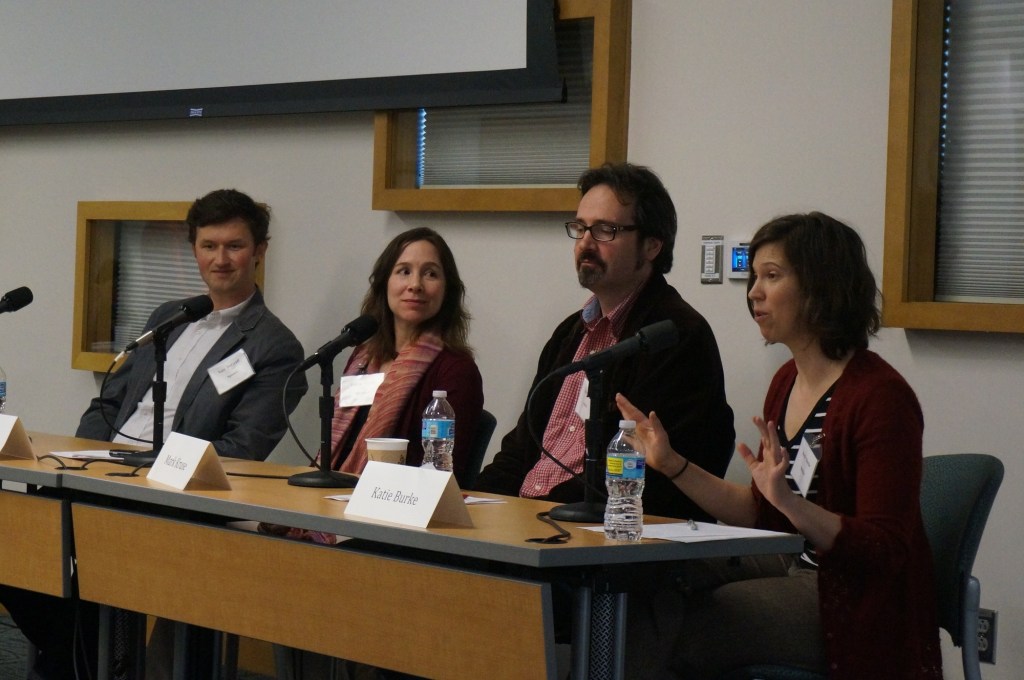
Our panelists consisted of a variety of science communication experts from editors, to faculty, to public information officers.
n between panel sessions, the attendees presented 1-minute popular science talks (pop talks) about their research. In these brief but information-packed snippets, we learned about the glorious world of poop, bugs, and ditches. Catherine Hueston, a grad student at Duke, said the pop talks were her favorite part of the workshop.
“I found it was a very good exercise, and it provided a great intro to network with people later because I already knew what they did!” she said.

The graduating class of ComSciCon-Triangle 2015
Local ComSciCon workshops, like ours, offer more than just the training in tools needed to be successful communicators. They also provide an exceptional opportunity for attendees to meet like-minded scientists-in-training from their area.
“It was nice to finally find a group of scientists who want to talk science, but in a fun and approachable way. Instead of feeling we had to impress each other with jargon, we impressed each other with our abilities to make difficult ideas simple to understand,” said Molly Matty, a grad student at Duke.
Just like the national workshop, ComSciCon-Triangle organized a write-a-thon for attendees to practice the not-as-easy-as-it-looks task of writing for the general public. The attendees had the chance to peer review each other’s work, as well as get advice from our invited experts with the hopes that pieces produced during the workshop will get published in popular science outlets.
In the few months since the workshop wrapped up, graduates of ComSciCon-Triangle have pitched to Slate, Scientific American, the Natural History Magazine, Nautilus, and have published at SciLogs and blogs at their home institutions.
The workshop closed with ten brave souls who volunteered to give public pop talks at the North Carolina Museum of Natural Sciences. Two of our invited experts, Brian Malow and Karyn Traphagen, channeled their inner Simon Cowell to serve as our judges, and hilarity ensued. Museum goers clustered around our pop talkers to learn about the glorious world of poop, bugs, and ditches just as our attendees had—but in a way that was accessible to the general public using the skills they had learned during the workshop.
Our science is cool—and we are showing how we can share it with the world!

The organizing committee of ComSciCon-Triangle including Sheena Faherty (Duke), Reggie Bain (Duke), Kelsey Ellis (UNC), Rosa Li (Duke), Mandy Liesch (NCSU), and Taryn Patterson (NCSU)
Overall, the workshop was a smashing success owing to the generous funds and donations provided by Duke Medicine, the Duke Graduate School, Duke Science and Society, NC State, UNC Research, the UNC Graduate School, Research Triangle Park, and the North Carolina Museum of Natural Sciences.
And, as organizers, we never get sick of praise like this from Michael Angus, a grad student at NC State: “This was a great workshop, thanks for bringing it to the Triangle!”
 ComSciCon