
Originally Published on September 24, 2015
Just two years on from the launch of ComSciCon, some of the longitudinal impacts of our programming on the graduate students who participate in ComSciCon workshops are already emerging. Here we check in with one ComSciCon alumna whose tremendous talent and skill for science communication, amplified by the connections and experiences she gained at ComSciCon, has catapulted her to remarkable success in the field of science journalism.
Catharine (Cat) Adams (@ScienceIsMetal) joined us in Cambridge, MA for the first-ever ComSciCon event two years ago, ComSciCon13 in June of 2013. She was a first-year graduate student in Organismal and Evolutionary Biology at Harvard University.
Cat arrived at ComSciCon passionate about the topic she was studying, the evolutionary ecology of the interaction betweens plants and fungi. Her eagerness to share her work on this compelling subject with a broader audience shone through in her application to the workshop. Cat was selected for one of 50 spots at ComSciCon13 from among more than 700 graduate student applicants nationwide.

ComSciCon was founded on the principle that enabling interaction between practicing scientific researchers at the beginning of their careers, graduate students, and seasoned science communication professionals, like journalists, will promote entrepreneurial and launch new collaborations. Cat’s experience at ComSciCon13 was emblematic of this.
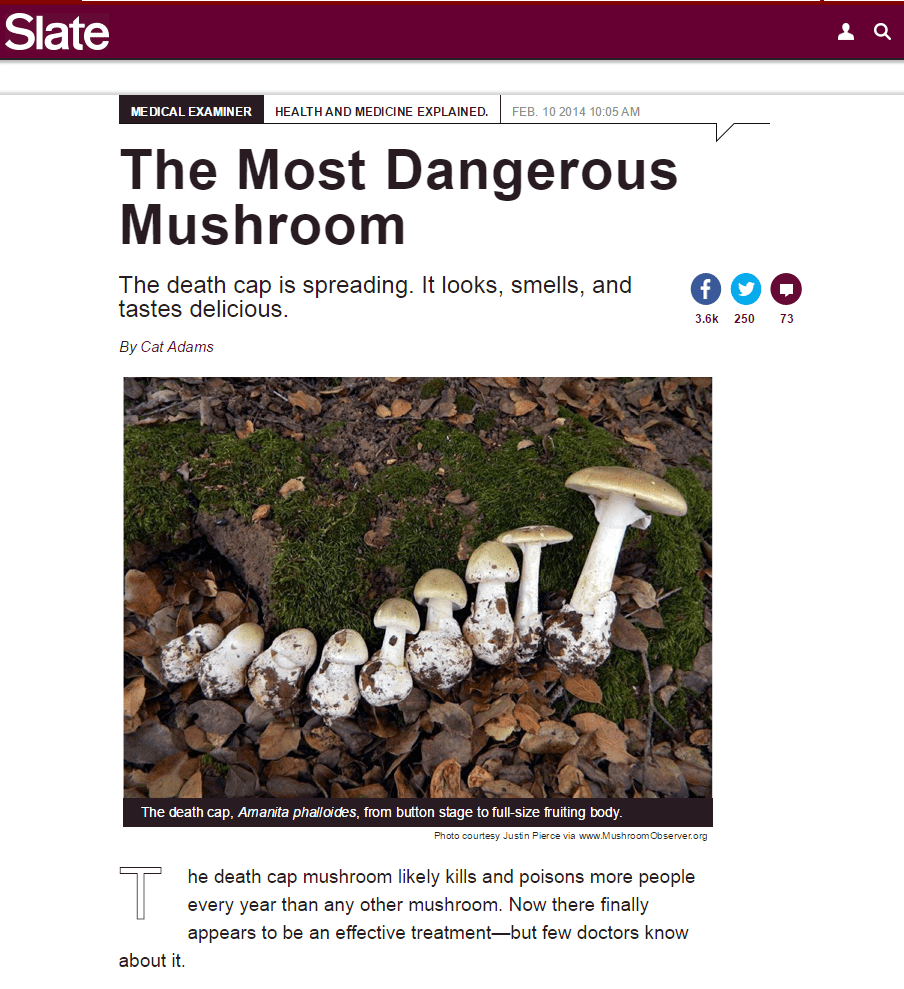
“During a break, I chatted with journalist Dan Engber, and he encouraged me to pitch my story idea about the Death Cap Mushroom to Slate,” she explained to us when we caught up with her this month. An author for Slate, New York Times Magazine, Wired, and others, and the winner of the National Academies of Science Communication Award in 2012, Dan was a standout among our inaugural cohort of invited experts from ComSciCon13.
After careful editing, first with her peers and our invited experts at ComSciCon and then with the editorial staff at Slate, her 2000 word article was published by the prestigious online magazine. Cat writes, “The piece was wildly successful, and was picked up by Discover, Popular Science, the New Indian Express, and more.” The article has been shared by almost 4000 readers on social media since it was published.
It was after this initial success that Cat realized the true impacts of her entrée into professional science writing, on both her scientific and journalistic careers. Cat views these effects as complimentary: “I think writing for the public makes me a better scientist. Writing is a key part of the scientific process, and practice makes perfect.”
The Slate piece was her introduction to Popular Science editor Paul Adams. They met and, as she told us, “sampled mushroom cocktails across Manhattan. We had a ton of fun.” Cat hinted at future collaborations between her and the team at PopSci still to come.

The exposure from Slate has had tangible impacts on her scientific research. Cat writes, “My writing skills have helped me win research money from amateur mycological clubs. Members of those same clubs have also helped me locate my study mushroom in the wild, and even brought me dried samples to my lab!” When she gave a talk about her experience mixing ecology with journalism and outreach, “Mycology Meets Social Media,” at the 2015 Fungal Genetics conference, it led to a new research collaboration with UK mycologist Lynne Boddy.
The most expansive effects of the article on her research may be still to come, she reports: “After reading about my research in Slate, folks at the science crowd-sourcing platform Experiment.com contacted me to encourage me to start a project with them, too. I plan to crowd-source with Experiment later this academic year.”
Meanwhile, Cat’s journalistic endeavors have continued progressing rapidly. The year following ComSciCon13, she was selected for a competitive new student writing position for BBC Earth. She published three articles with the BBC about fungi, sharks, and carnivorous pitcher plants. “The gig was great practice and connected me with great scientists around the world, too,” Cat reflects.
She recognizes that her status and engagement as an active researcher gives her an advantage in the news media. Writing of graduate students, she says, “Because we are elbow deep in the scientific trenches, we can also know about cool stories before traditional journalists. Scientist-journalists can publicize certain stories faster.”
Prior to attending ComSciCon, Cat had found outlets for her writing in university publications, and her personal blog Science is Metal. As an undergraduate student at the University of Washington, she published articles in Northwest Science and Technology Magazine and, while at Harvard, she published in Science in the News Flash. That conversation with Dan Engber at ComSciCon proved transformative — in her words, “The conference honestly jump-started my journalism work.”
Having completed her Masters at Harvard and now a PhD student at UC Berkeley, Cat studies Amanita phalloides, the deadly “death cap” mushroom. She is leader of the Unconscious Bias Project, a social action group at Berkeley informing researchers in STEM fields about this barrier to diversity, and enabling them with evidence-based strategies to combat it.
Pointing us towards another recent Slate article by Ben Ewen-Campen, a fellow biologist and friend of Cat’s, she reflects on the fundamental value that scientists bring to the news media: “Our familiarity with the scientific literature allows us to share fascinating stories that would otherwise remain known only to scientists.”
 ComSciCon