
Originally Published June 12, 2025
by Kimberly Lato, (ComSciCon National Flagship Conference 2024)
Last summer, while on a hiking trip in Vancouver, I saw a sign that read, “Feeding birds is so unhealthy that British Columbia SPCA now consider it indirect animal cruelty”. This statement struck me, as it might be striking you now. This sign was planted at an outdoor market along the canal, where I had wandered in search of a scenic lunch spot with a view back toward the city. Like most coastal scenes, gulls lingered nearby, waiting for someone to leave their meal for only a moment so they could launch themselves in to steal whatever food scraps were left behind. Looking at these gulls eating human food, and then looking back at the sign, I thought, ‘Animal cruelty? Isn’t that a bit extreme?’. To answer this question for myself, I went on a quest sifting through news articles, expert commentaries, and scientific research papers to learn more about why exactly feeding wild birds might be considered so harmful to them.
Let’s start with bird feeders
According to reports, over 57 million people in the United States have bird feeders. This number sky-rocketed during the Covid-19 pandemic, when people stuck at home were looking for activities to keep themselves occupied. Bird feeders are a great way to enjoy local wildlife in the comfort of your own home, though it seems to come at a cost to the birds. Bird feeders may help some small songbirds by providing a reliable food source during long migrations or harsh winters, when food may be scarce. However, bird feeders act as a single location where many birds can congregate, making them hotspots for predators and epicenters for disease transmission. During the Covid-19 pandemic, we learned the harsh reality of what having densely populated areas means for human health- but now we must also apply this knowledge to birds. In the last ten years, wild bird populations have been stricken by serious diseases such as avian cholera and avian flu. Bird feeders can facilitate the rapid spread of these illnesses and ultimately affect a large number of birds over a short period of time.
What about feeding birds at the park?
Feeding bread to birds (usually ducks or geese) at the local park is a favorite past-time for many people. However, bread does not naturally occur in the diets of these animals and lacks a lot of nutrients that birds need to help them develop and maintain a healthy body. You may have seen geese around your neighborhood with what looks like a broken wing- where one (or both) wing(s) sticks out to the side. Many times, this is not a broken wing, but rather a condition called “angel-wing” or “airplane wing”: a direct result of eating too much bread. Eating bread causes a nutritional deficiency in young birds, leading the wing joints to bend or twist as it grows, inhibiting the bird’s ability to fly.
What about feeding birds more natural food?
Even feeding birds more natural foods can be harmful to them. Feeding birds any kind of food causes them to become reliant on humans, and eventually imprint on them. Imprinting is when an animal becomes accustomed to, and even trustworthy of, humans. It removes the innate fear that animals have of people. This sounds nice at first- after all, I wouldn’t want animals to run around fearing me. However, if animals become reliant on or attracted to humans, they may never learn how to take care of themselves. Even more, animals who are imprinted have a much higher risk of being hit by cars or killed by hunters because they haven’t learned to avoid people.
Placing the blame on birds
Let’s bring it back to the gulls I saw in Vancouver who were waiting impatiently for oddments of food to be left behind. Even this accidental feeding of birds was causing human-wildlife conflict before my very eyes. The pervasiveness of gulls was agitating, disturbing peoples’ peaceful lunchtimes and creating negative public perception of these animals. Human conflicts with wildlife are often seen as issues in which an animal needs to be controlled or removed. In other words, it’s the animal that is the problem. However, it’s not the animal’s fault. Human-wildlife conflicts arise because humans are constantly changing an animal’s surroundings and way of life. Therefore, it’s not the animal that has to change to reduce conflict, but rather us.
Should feeding wild birds be considered animal cruelty?
After doing my research, I found that most of the benefits that come with feeding wild birds are for humans, not birds. Was that sign I saw in Vancouver right? Should feeding wild birds be considered animal cruelty? Honestly, I’m not sure. Regardless, there is strong evidence that feeding wild birds does more harm than good and can prevent birds from living their best bird life.
Caring about animals is a unique component of the human conscience and one we should not avoid. As we change this world to benefit humans, we must minimize the impact that we have on wildlife so they can live their truest and healthiest lives. The next time you spot a wild bird—in the park, your backyard, or even by the roadside—appreciate its beauty from a respectful distance. Savor the quiet moment it offers, but also help ensure these birds remain healthy and free so future generations can enjoy them too. Caring about animals is showing them respect and putting their needs above our own wants. Caring about birds is letting them find their own food.
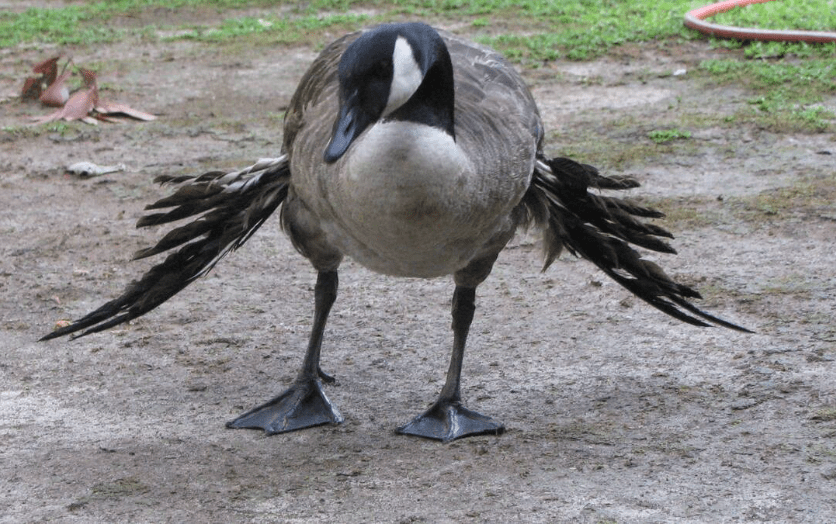
Photo: A Canada Goose with severe angel wing, ©Nature and Wildlife By Jean.
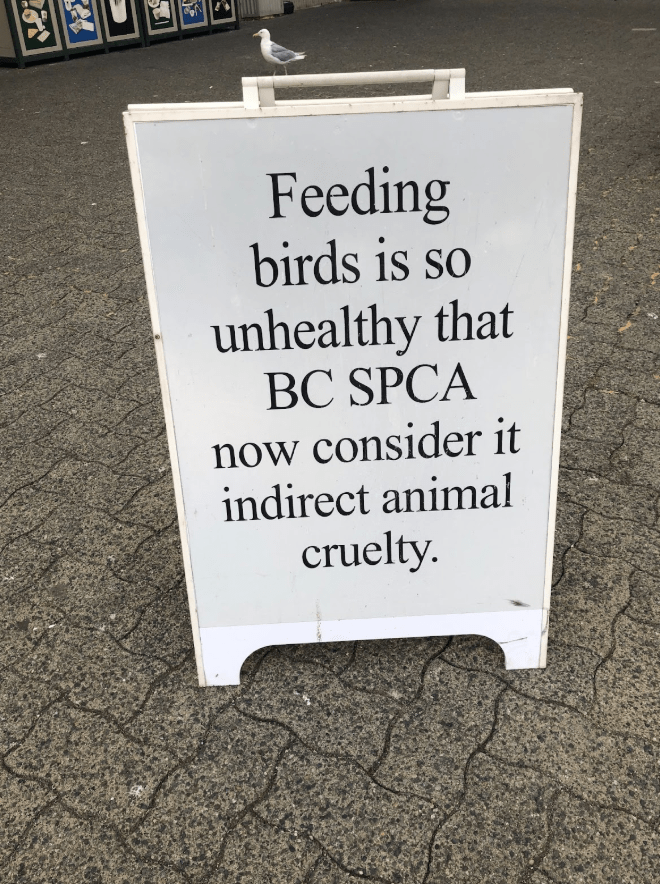
Photo: The sign I saw in Vancouver, CA, that inspired this post. © Kim Lato
References:
Why Do We Feed Birds—and Should We? A Q&A With the Experts. https://www.allaboutbirds.org/news/why-do-we-feed-birds-and-should-we-a-qa-with-the-experts/?utm_campaign=bird%20academy%20general&utm_source=facebook&utm_medium=social&utm_term=post&utm_content=WhyFeedBirdsFB
Feeding Birds in America: Culture, Commerce, and Conservation. https://www.tamupress.com/book/9781623492113/feeding-wild-birds-in-america/
To Feed or Not to Feed Wild Birds. https://www.fws.gov/story/feed-or-not-feed-wild-birds
————————————-
Kim received her Bachelor’s of Science in Environmental Science from Binghamton University and her Doctor’s of Philosophy in Marine Science from Stony Brook University. She’s currently a quantitative ecologist at a research-focused non-for-profit. Her research focuses on understanding the behavior of large marine animals, such as seabirds and whales, and how human activities can impact these charismatic creatures. Her research has been featured in Scientific Reports, Marine Pollution Bulletin, Ecosphere, and many other peer-reviewed research journals. Outside of her research, she conducts free community outreach programs, for both kids and adults, focused on environmental and marine science. In her free time, you can find her hiking, kayaking, gardening, and hanging out with her dog.
 ComSciCon