Welcome
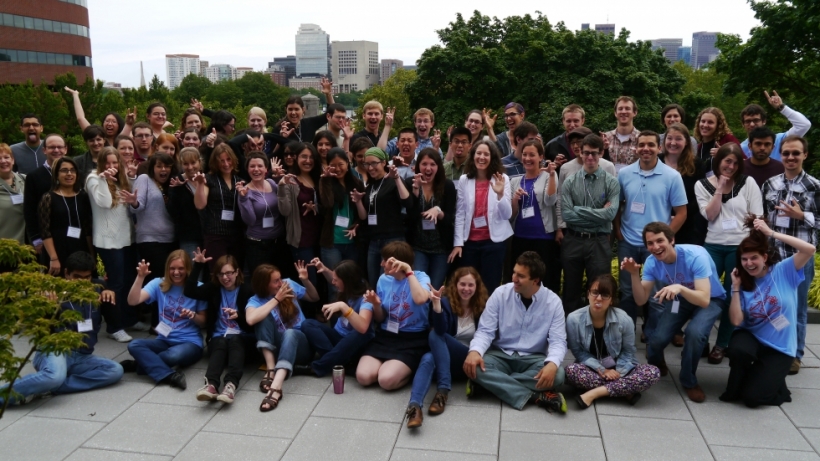
The attendees were selected based on their achievement in and enthusiasm for communicating science 
Truly a highlight of the workshop, every ComSciCon session opened with 1 minute “pop talks” from attendees 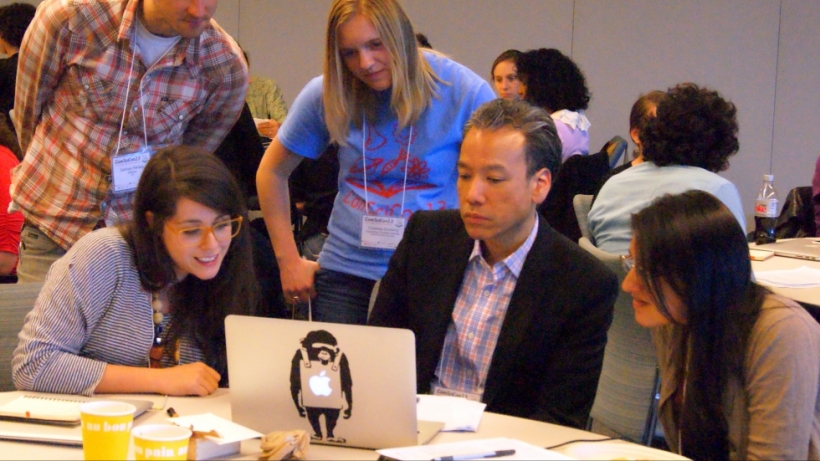
“Anything that weaves science a little more closely into the fabric of the world is worthwhile.” 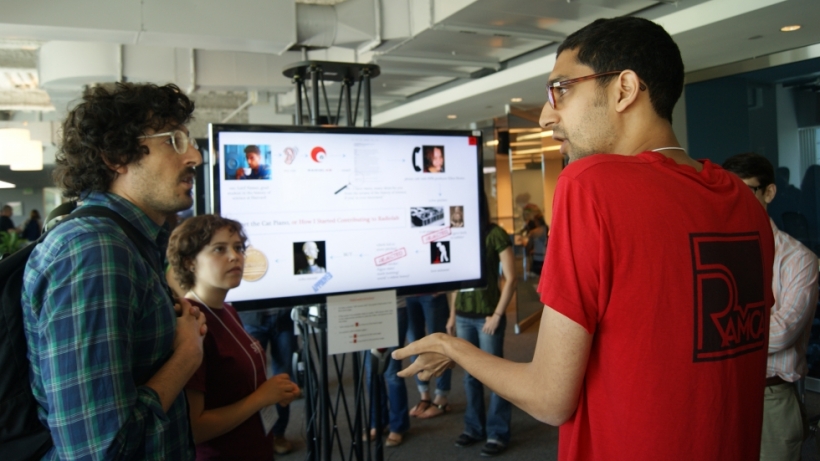
ComSciCon attendees shared the many unique communication and outreach initiatives using video and web content on digital posters 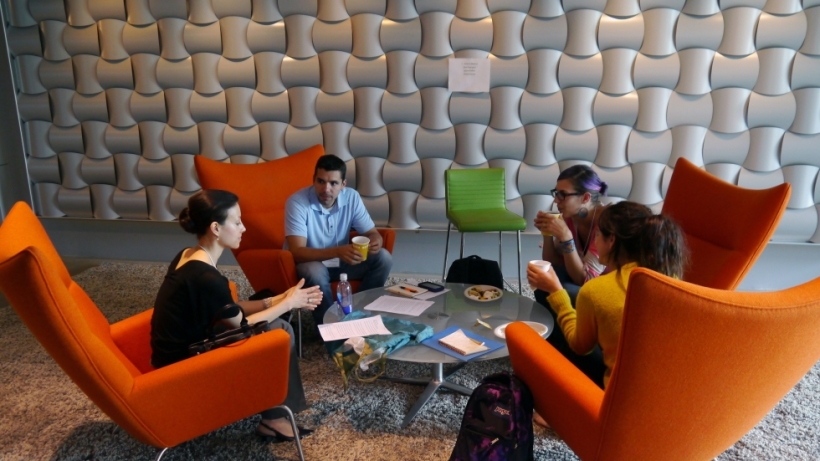
Attendees wrote two-page articles using the ideas from the day’s sessions and and then met with experts for feedback.
| Communicating Science Workshop, June 13-15, 2013, Microsoft NERD Center, Cambridge, MA 02138 | |
| Overview Fifty graduate students in all fields of science and engineering gathered in Cambridge, MA on June 13-15th, 201 3 for the Communicating Science workshop (ComSciCon). This first-of-its-kind event, fully organized and operated by a team of nine graduate students, empowered young scientists to act as ambassadors for their fields by learning from experts, workshopping original writing pieces, and interacting with their peers. The attendees were selected from from more than 730 applicants based on their achievement in and enthusiasm for communicating science to diverse audiences. As we issue this report, the list of accomplishments by our attending students is already long. With the connections now established between these fifty young leaders in science communication, and new collaborations already formed, this list will continue to grow in the coming months. | |
| Expert PanelsTwenty-one expert science communicators from theatre, journalism, publishing, and more discussed their work and answered questions from attendees during seven panel sessions. Amanda Martinez, a writer for The Atlantic and others, advised attendees that her favorite writing “accorded me the basic human dignity of allowing me to draw my own conclusions. | Pop talksTruly a highlight of the workshop, every ComSciCon session opened with 1 minute “pop talks” from attendees about their research. Attendees wielding “awesome” and “jargon” cards provided live feedback to the speakers. |
| Write-a-thonOn Thursday night attendees wrote two-page articles using the ideas from the day’s sessions. On Friday, small groups of students dished out comments and then met with experts for deep reads and thoughtful feedback. | Poster Session ComSciCon attendees shared the many unique communication and outreach initiatives they are leading at locations around the country using video and web content on digital poster boards. |
| New student collaborationsSaturday’s technical session featured a tutorial for starting new Astrobites spin-offs. Within an hour, ComSciCon attendees had founded the first spin-off site to be born from the workshop: GeoSciBites, focusing on undergraduates in the geological sciences. Other attendees are launching -bites sites for particle physics, ocean ecology, and STEM education. | Publishing Many students sought publication for their writing in one of several outlets which have committed to accepting submissions from ComSciCon attendees. by our partner outlets. Publications list. |
Social Media
2013 Social Media
There are many ways to check out what happened at ComSciCon and follow-up information. If you are an attendee please join our Facebook and LinkedIn groups.
If you just want to check out what happened during the workshop checkout the live blogging that happened on Astrobites during day one and day two. Elisabeth Newton also made a great series on Storify about the conference check it out – Volume 1, Volume 2, Volume 3, and Volume 4.
Participants
Cat Adams (@ScienceIsMetal, blog)
Cat received her BS from the University of Washington in Ecology and Evolution and is now a first year PhD student in Organismal and Evolutionary Biology at Harvard University. She is interested in the evolutionary ecology of plant-fungal interactions, and has spent years studying wild chili peppers and the molds they fend off with their spice. Cat is expanding her dissertation work to consider how plants have evolved with the symbiotic fungi on their roots that exchange nutrients. She has several science journalism articles published in Northwest Science and Technology Magazine (www.nwst.org) and Harvard University’s Science in the News Flash (http://sitn.hms.harvard.edu/sitn-flash/). When she feels like being less serious, Cat writes for her heavy metal music-themed blog, Science is Metal.
Alice Alpert (@alicealpert, blog)
Alice Alpert is a PhD student in the MIT-Woods Hole Oceanographic Institution Joint Program in Oceanography where she studies coral reefs and ocean currents in a changing climate. As President and co-founder of the Broader Impacts Group, she develops innovative strategies to engage the public with science. Following her graduate studies, Alice hopes to pursue a career linking scientific research and decision makers to create effective policies for climate change.
Christian Bernt Haakonsen
Christian Bernt Haakonsen is a graduate student in the department of Nuclear Science and Engineering at MIT. He does computational plasma physics research at the Plasma Science and Fusion Center, where he has given tens of outreach presentations and tours to visitors of all ages and backgrounds. Christian has a strong interest in energy-related research, but also has a background in astrophysics and broader interests ranging from biology to economics.
Gabriele Betancourt-Martinez (homepage)
Gabriele Betancourt-Martinez is a second year graduate student in astronomy at the University of Maryland, College Park. Her current research involves making laboratory measurements of charge exchange, with the eventual goal of using her data as experimental benchmarks to improve theory. She attended Yale University for undergrad, where she investigated the kinematics of star-forming cores in the Perseus molecular cloud, and optimized the circuitry for a small-scale liquid xenon dark matter detector. She is currently a graduate mentor for a brand new group for early undergraduate women taking astronomy classes at UMD, which seeks to provide support, connections, and food for thought to women who may envision themselves as future scientists.
Breanna Binder (homepage)
Breanna Binder is a graduate student in the University of Washington astronomy department. She got her undergraduate degree in physics from the University of California, San Diego. Breanna is actively involved with UW’s Robinson Center for Young Scholars, which brings fun and challenge courses in all disciplines to gifted kids in the Seattle area. Currently, Breanna co-teaches a three-week summer class on astronomy to gifted 5th and 6th graders, and during the year she teaches a wide range of science classes to kids 4th-8th grade through the Robinson Center’s Saturday program.
Anny Chung (homepage, TED page)
Anny is a PhD student in biology (ecology) at the University of New Mexico. She grew up in Taiwan and New Zealand, received an A.B. in biology and international studies from Washington University in St. Louis, and was at Rice University as a PhD student before moving with the lab to New Mexico. Her dissertation work focuses on how interactions between plants and their microbial symbionts alter competition and coexistence between plant species. She enjoys teaching and mentoring at all levels, and sees it as a step in promoting access to knowledge for all. In her spare time, she is a musician and volunteers as a translator for ted.com.
Marina Damiano
I defended my PhD thesis at Northwestern University. My thesis title was “Synthesis and Characterization of Biomimetic High Density Lipoprotein Nanoparticles to Treat Lymphoma.” I am interested in all aspects of biomedical research. As far as science communication experience goes, I am trained to be able to customize my research story for any audience and specialize in communicating science to non-scientists. I am currently a scientific communications intern at a full service life sciences advertising agency.
Kari Debbink (@KariDebbink, blog)
I earned my B.A. in biology from New College of Florida, and started my career as a middle school science teacher. During that time, I earned my M.Ed. from Endicott College and my Secondary I Montessori teaching credential. After nine years of teaching, I entered a Ph.D. program at UNC-Chapel Hill in Microbiology and Immunology where I am currently finishing my 4th year. My dissertation research involves mapping potential neutralization eptiopes, developing a vaccine platform, and deciphering the evolutionary mechanisms of GII.4 noroviruses. I am also generally interested in emergent RNA viruses, viral evolution, and gastrointestinal pathogens. I enjoy participating in science-related outreach activities including DNA Day, UNC Research Day, the UNC Science Expo, and mentoring activities for undergraduate research students.
Liz M. B. Doran (@dukegreendevil, blog, homepage)
I am currently studying sustainability as a graduate student at the Nicholas School of the Environment at Duke University. My research interests include characterization of the emerging sustainability science and sustainable systems analysis. Before coming to Duke, I received my undergraduate degree in environmental engineering from Tufts University in Somerville, MA. After graduation, I worked for several years as an environmental consultant, before returning to academe. In 2011 I finished a masters degree at Duke in mechanical engineering. During my time in North Carolina, I have served on various University and student committees, and spend the balance of my time running and exploring the state. For several years, I wrote the ‘green devil’ column for the student newspaper and maintained a blog by the same name. Since that project has been on hiatus, I have focused on deepening the academic rigor of my understanding of sustainability related issues and am currently in search of the next phase of meaningful outreach.
ComSciCon Organizer Courtney Dressing (homepage)
I am a third-year graduate student in the Department of Astronomy at Harvard University. I obtained my bachelor’s degree in Astrophysical Sciences from Princeton University in 2010 and my master’s degree in Astronomy and Astrophysics from Harvard University in 2012. My research focuses on determining the frequency, characteristics, and detectability of Earth-like planets orbiting small stars. The majority of the stars in the galaxy are much smaller than the Sun, so understanding the fraction of small stars that host Earth-like planets is crucial for estimating the number of habitable worlds in the galaxy. My current outreach activities include serving as a docent for the monthly public observing nights at the Center for Astrophysics, participating in monthly web-based Astronomy Chats at the National Air & Space Museum in Washington, D.C., mentoring younger students interested in science, and serving as the chair of the Astrobites Hiring Committee. I am a member of the ComSciCon Organizing Committee and was one of the founding authors of Astrobites.
Jesse is a Ph.D. student in the Computer Science Department at Carnegie Mellon university. He studies natural language processing (NLP), focusing on building technologies that enable computers to interpret metaphors in useful and intelligent ways. Originally from New Jersey, Jesse received his bachelor’s degree in computer science from MIT. He has taken his computer science skills into a wide variety of contexts, including software companies, charitable organizations, and physics laboratories. He has also taught college programming courses and helped run computer science outreach programs for children. Along with several other Ph.D. students, Jesse founded a program at CMU called Public Communication for Researchers (PCR), which runs workshops with themes such as storytelling, interacting with the media, and improv for scientists. PCR has run seven seminars and workshops over the past year, and the founders are currently working on a five-year plan to propose to the university for incorporating the program into official graduate training.
Clare Fieseler (@SeaFieseler)
Clare grew up in a loud, Irish-Catholic family from Jersey, where stories and, of course, exaggeration know no bounds. Halfway through college, she opted out of an English major to study environmental science and policy. Her first job merged her two loves: the environment and story telling. She worked in wildlife film production at National Geographic, learning narrative through a lens. She eventually missed the exploration of science, and, in 2008, returned to school. Clare received a Masters at Duke University and currently pursues a PhD in Ecology at UNC-Chapel Hill. Her research wrestles with the complexities of ecological resilience, including it’s applications for environmental management. Clare is a strong believer that the wonder of science can open eyes and minds. We have a shot at that if the next generation of scientists can learn to become storytellers. She, and a cohort of like minded PhD students, currently run The Duke/UNC Scientist with Stories Project. Planning audio/photography/film workshops for fellow students keeps her happily sleep deprived, while dissertation research keeps her grounded in what’s important. Clare splits her time between DC and NC with her husband, who makes it all possible.
Josh Fuchs
I am a graduate student in astrophysics at UNC-Chapel Hill. My undergraduate degree is in physics from Rhodes College. I study cataclysmic variable stars, which are binary star systems in which one star is transferring mass to the other star. I try to understand what causes this mass transfer to change over time. I am an author for Astrobites. I also am a Universe Awareness Student Ambassador, meaning I conduct outreach projects geared towards elementary school children.
Amanda Gallinat (@amandagallinat, blog, tumblr)
Amanda is a first year graduate student in the Primack Lab at Boston University where she studies the effects of climate change on the timing of seasonal biological events. A graduate of Carleton College, Amanda has worked as a field biologist on a range of projects and taxa, from monitoring the effects of biofuel harvesting on insect biodiversity to the reproductive success of woodpeckers following forest fires. For the past two years, Amanda has worked with long-term bird banding stations in the United States and abroad, conducting outreach activities for adults and children on the importance of long-term records for songbird conservation. As a new member of the Primack Lab, she has initiated a lab blog and utilized short videos to document and publicize the local effects of climate change.
Megan Harberts (@meganharberts, blog)
I am originally from Albuquerque, NM where I grew up in a science-oriented family. I received my bachelor of science in physics and mathematics from New Mexico State University in 2009. I am currently finishing up my 4th year of graduate school working on my PhD in physics at The Ohio State University. I work in an experimental condensed matter lab doing research on organic spintronics. Outside of graduate research I participate in many outreach activities throughout the year including science fair judging and helping with physics demos for school groups and the Ohio State Fair. I am also one of the founders and active board members for the blog “A Day in the Life in Physics at OSU”.
Zach Hartwig (homepage)
I’m a sixth year PhD student in the nuclear science and engineering department at MIT, applying particle simulation and detection to solve challenges in fields like fusion energy and nuclear security. I have been active in public outreach activities as part of MIT’s Plasma Science and Fusion Center, as well as leading and participating in several science advocacy trips to meet Congressional offices in Washington D.C.
Leanna Heffner (@LeHeffner)
Twelve years ago I began my career in science research as an undergraduate at Vassar College, and since then I have continuously studied the ecological impacts and management of nutrient pollution and climate change in the coastal environment. Currently I am finishing up my Ph.D. at The Graduate School of Oceanography and plan to continue my work as a coastal ecologist studying human impacts. I am also passionate about science communication, outreach, and policy/management, which began with a 2-year IGERT (Integrative Graduate Education and Research Traineeship) focused on problem-solving coastal issues. For the past 7 years of my graduate career, I have collaborated with a number of groups to lead and organize various outreach and policy-oriented activities. This includes workshops for teachers and journalists, in-class and field-trip activities with students K-12, climate change symposiums for decision-makers and scientists, coastal restoration projects, and national conferences for coastal researchers. Currently I serve as the Student Member-at-Large on the Governing Board for the Coastal and Estuarine Research Federation, and am the chair of their Social Media Committee. I have participated in several science communication workshops, including those led by Carl Zimmer and Bora Zivkovic. I am greatly looking forward to ComSciCon, which will no doubt serve as an invaluable learning experience!
Jareth Holt
My undergraduate degree is in math, but I was also interested in physics, education, and environmental science. I am currently a PhD student pursuing the Climate Physics and Chemistry degree and the Science Policy certificate. My research interests are quite varied: climate dynamics, large-scale atmosphere and ocean circulation, fluid mechanics and turbulence, ocean biology and ecology, and atmospheric aerosol chemistry. My current research is on developing reduced models of the complex interactions of sulfur and nitrogen that produce air pollution. These simpler models can be used more efficiently than full models in designing and analyzing air quality policy. Most of my outreach activities have involved teaching. I designed and taught a middle school-level course on weather through MIT’s HSSP program. This course involved a lot of fluid mechanics demos using a special rotating tank.
Caroline Jakuba
I’m finishing up my doctorate at UCONN in Genetics and heading off to a postdoc at Wisconsin-Madison this summer to pursue science education research. While my doctorate was a fascinating project blending classical developmental biology, stem cells, and transcriptomics, teaching has always been my true passion and I’m excited for this next chapter. My goal is to improve the scientific literacy of our undergraduates through curriculum reform and the inclusion of more communication skills tutoring. Currently I work with professors to include more problem-based learning activities in their courses and also lecture in a Communication Skills class on effective presentation design and delivery. As I head into science education research, I’d like to start writing Op-ed pieces on the National reforms in STEM education to inform parents of what’s happening in their schools and communities.
Brittany Jeye (@BrittanyJeye)
Brittany Jeye is the Coordinator of the NSF-funded “National Living Lab Initiative” at the Museum of Science in Boston – an onsite research program which aims to educate the public about cognitive development by immersing museum visitors in the process of scientific discovery. She graduated from Boston College in 2012 with a B.S. in Biology and a B.A. in Psychology, and will soon be returning to Boston College to pursue her Ph.D. in Cognitive Neuroscience. She has worked at the Museum of Science in various capacities for over four years and is passionate about communicating science and learning to the public.
Tyler R. Jones
I received a BS in Civil Engineering and MS in Environmental Studies from the University of Colorado. I am now a PhD candidate in Biogeochemistry studying abrupt climate change from Greenland and Antarctic ice cores (also at the University of Colorado). My research interests include stable isotopes and chemistry in ice cores as a proxy for paleo-ENSO reconstruction, rapid climate shifts, and land-ocean-atmosphere interactions. I have a special interest in film and photography, including working for Discovery Channel’s Storm Chasers and the Extreme Ice Survey. I will co-teach a course on communicating climate change through film in Fall 2013.
Meg Krench
I’m a PhD candidate in the Brain and Cognitive Science Department at MIT. My dissertation research focuses on Huntington’s disease, an inherited neurodegenerative disorder for which there is no cure. To study how the disease causes neuronal death, our lab has inserted a piece of the human disease gene into the fruit fly genome. Now, I’m using a technique called RNA interference to turn off hundreds of genes, one-by-one. If the flies become healthier when a particular gene is turned off, then that gene may be involved in Huntington’s disease. This project could eventually identify new targets for treatment. While working on my doctoral thesis, I have come to realize that my favorite part about research isn’t the planning and lab work, but the opportunity to share knowledge with others. I’m considering careers in higher education, science museums, and science communications. I’m excited to say that I’m developing curriculum to teach a course at Tufts University ExCollege this fall. The undergraduate course, titled Neuroscience and Criminal Justice, aims to bridge the gap that we find all too often between science and liberal arts. My course is designed to increase scientific literacy among students from diverse educational backgrounds. Then, students will apply their scientific knowledge to approach ethical and technical gray areas in the legal system. In addition to my interest in neuroscience education, I’ve also enjoyed teaching science in less formal settings. My favorite outreach experience has been through the MIT Museum. Whether it’s helping students build their own Rube Goldberg machine or doing an interactive demonstration with Lego DNA, volunteering at the MIT Museum always presents fun new ways to communicate scientific concepts. Other outreach activities include the Cambridge Science Festival, Science Club for Girls, and Penn State Science Lions.
ComSciCon Organizer Susanna Kohler (homepage)
I received my BS in physics from UC Santa Barbara in 2008. Since then I’ve traded the Pacific for the Rockies — I’m now in my fifth year of a PhD program in astrophysics at the University of Colorado Boulder. I’m currently working on research in two fields: astrophysics and science education. For my astrophysics research, I get to study some of the most mysterious objects in the Universe: black holes! In particular, I research some of the extremely energetic phenomena associated with them, such as jets that get accelerated almost up to the speed of light. For my science education research, I’m studying strategies for teaching future scientists to communicate science to a general audience — like this workshop! I love science outreach and do as much of it as I can. One of my favorite activities is being an author for Astrobites (a sort of reader’s digest of astronomy research), but I also love in-person work like hosting public open houses at the observatory on campus and giving astronomy talks at the local planetarium. After I get my PhD, I hope to pursue a career in science communication and public outreach.
Margaret Kosmala (@margaretkosmala, homepage, blog)
I am finishing up my Ph.D. in Ecology at the University of Minnesota while on a Smithsonian fellowship at the National Museum of Natural History in Washington D.C. I study the effects of human disturbance (agriculture, biodiversity loss, introduced disease, and climate change) on ecosystems. At the Smithsonian, for example, I’m looking at the effects of climate warming on prairie insect community structure. I have a B.S. in Computer Science from Brown University. My computer expertise has led to some exciting collaborations, including Snapshot Serengeti, a citizen science project that launched in December. At SnapshotSerengeti.org, my collaborators and I ask volunteers to identify the animals in photographs taken by automatic cameras set up in the Serengeti. With a million images coming in per year, we need our volunteers to do the science, but we also want to help them understand the ecological context of our project and the process of science itself. Over 15,000 people have visited our site and we communicate regularly with a core group of several hundred volunteers via a dedicated forum, a blog, Facebook, and Twitter.
Mandy Liesch (blog)
Mandy is an artist trapped in the body of a soil scientist. She is a PhD student at North Carolina State University, researching how much storm-water soils in a rapidly urbanizing county can infiltrate to maintain water quality. The east coast is a stark contrast from her Masters degree in Agronomy on the sweeping plains of Kansas. Mandy (also known as Dirt) is currently in charge of writing and managing web content for K-12 soils education and teachers site for the Soil Science Society of America. She also was an author for a teachers guide for an elementary/middle school soils book, and has a chapter in a soils textbook for high school students. She also writes and runs environmental and soil science programs for the Girl Scout Council of the North Carolina Pines.
Grace Lindsay (@neurograce, blog)
I am a PhD student in Neuroscience at Columbia University. I got my BS in Neuroscience from the University of Pittsburgh in 2007, and then spent about a year doing research at the Bernstein Center for Computational Neuroscience in Freiburg, Germany. I am mainly interested in computational models of cognitive processes, but I also encourage connecting theory directly with experiments. Since starting at Columbia, I’ve participated in many local outreach programs including classroom visits, museum events, brain expos, and social media organization for Brain Awareness Week in New York City. I also blog about neuroscience at neurdiness.wordpress.com.
John S. Mancini
I received my B.S. from Richmond University in 2011 and am currently pursuing my Ph.D at Emory University in physical chemistry. My thesis work is focused on creating new theoretical models to describe fundamental chemical processes with particular interests in the motions of molecules at their absolute lowest temperatures. In addition to my research, I am producing a video series designed to showcase the experiences and ideas of chemistry professors.
ComSciCon Organizer Kara Manke (@Kara_Jean7)
Kara Manke is a Ph. D student studying Physical Chemistry at the Massachusetts Institute of Technology. She is originally from the Twin Cities, where she received her B. A. in Chemistry from Macalester College. In her graduate work, she uses high-frequency sound waves to study the properties of complex materials, including viscous liquids and nanostructured composites. She loves to write both fiction and non-fiction, and has written for the blog Chembites and the Energy Frontier Research Center Newsletter, where she currently serves as a member of the Editorial board. She is also involved in the MIT Science Policy Initiative, and in March 2013 traveled to Washington D.C. with a delegation of MIT students to talk to policymakers about the importance of science funding.
Carrie McDonough (@tentatickle, homepage)
Carrie is a first year Ph.D. student in Chemical Oceanography at the University of Rhode Island Graduate School of Oceanography. She received her B.S. in Chemistry from MIT in 2008 then spent some time in environmental consulting before going back to school. For her Ph.D. project, Carrie is studying emerging contaminants in the Great Lakes region. As commonly used chemicals such as polybrominated diphenyl ethers (PBDEs) and polychlorinated biphenyls (PCBs) are proven harmful and regulated, other compounds that are similar in structure take their place in industrial applications. Carrie is interested in developing analytical and toxicological methods to detect these compounds in Great Lakes air and water and studying how they behave in the environment. Sampling efforts associated with this project rely heavily on volunteers throughout the region, and Carrie is interested in ways to effectively recruit and train non-science background volunteers and students to participate in environmental monitoring studies. Additionally, Carrie has been participating in outreach projects aimed at encouraging high school girls to explore opportunities in scientific research. Carrie is also a musician – she plays guitar and is learning to play the musical saw. She is lead singer and rhythm guitarist for the Boston-based rock group FORTRAN.
Katie McGill (@physicskatie, LinkedIn, tumblr)
Katie McGill has been having a love affair with physics since her first day in the class her junior year of high school. Fortunately, this meant that she (mostly) had her answer to the all-important question of “What are you going to do with your life?”. Heading to the College of Creative Studies at the University of California, Santa Barbara to complete her B.S. in Physics, Katie quickly became interested in physics research and participated in a variety of projects during her tenure as an undergrad. These experiences, combined with advice from one of the grad students in her department (“You should go to grad school if you love physics.”), culminated in Katie’s decision to attend Cornell University to work on her PhD in experimental condensed matter physics with Professor Paul McEuen. Specifically, Katie is interested in the growing field of two-dimensional semiconductors and the unique physics that emerge when electrons are confined to a single crystalline layer of material. She spends many of her days in the Cornell NanoScale Science & Technology Facility making tiny devices (ten times smaller than the width of a human hair!) for her experiments. Throughout her education, Katie has enjoyed sharing her love of physics with the public, particularly with children and young adults. Interested in the potential of YouTube as a platform for communicating science, Katie launched The Physics Factor, “A vlog for all your physics needs!”, on YouTube in 2013, and she looks forward to continually improving her ability to describe physics to the public while she completes her PhD.
ComSciCon Organizer Shannon M. Morey (homepage)
I grew up in a small town in Michigan’s thumb. I graduated in 2010 from Michigan State University with a B.S. in Chemistry. I am currently finishing up my M.S. in Chemistry at MIT where I have been developing synthetic polypeptides for biomaterial applications. In July, I will be leading lesson and curriculum development for Science from Scientists, a Boston area STEM education non-profit. As an undergraduate, I ran a student-led science outreach organization called Science Theatre. As a graduate student, I have been working with the East Boston community to increase science opportunities there. I mentor science fair students, judge the science fair, and have started a middle school/high school environmental science mentoring program. I have also worked with the national non-profit, Citizen Schools to develop and teach a hands-on science lessons to 6th and 7th graders. I am a co-chair of the ComSciCon Organizing Committee.
Elaine Oberlick
Hello all! I am a PhD student in Biomedical Sciences at Harvard University. I come to Boston from Arizona via Atlanta. I went to Emory University in Atlanta for college, where I studied Biology and Spanish, researched triple-negative breast cancer, and ran a science magazine. During my summers, I researched epigenetics through fruit flies.
I started graduate school in Fall 2011, and found the perfect lab to combine my interests: I am studying cancer epigenetics in the lab of Dr. Charlie Roberts at DFCI. I want to help inspire the next generation of scientists and medical doctors, and have been able to do so through involvement with HPREP (Health Professions Recruitment & Exposure Program), a program to recruit underserved and underrepresented high school students into science and medicine. As Curriculum Coordinator, I have been involved with planning our curriculum and ensuring that it is taught at an appropriate, accessible, and fun level for the students. I love teaching and inspiring these students, and helping them see that science can be cool!
Alice Olmstead (@aliceolmstead, homepage)
I was born and raised in a small, liberal, artistic city in Massachusetts (Northampton, home of Smith College). Following in the footsteps of my older sister, I went off to Boston for my undergraduate degree; specifically, I attended Boston University for four years and majored in Astronomy and Physics. Needing a break and some fresh air after graduation, I again followed my sister and traveled across the country to sunny Santa Barbara, CA. I landed an awesome job tutoring astronomy, physics, and math at UCSB (and a less-awesome but reasonable job serving coffee). I returned to the east coast for graduate school in the Astronomy Department at the University of Maryland, where I am now. I have been working with Jane Rigby at Goddard Space Flight Center investigating the morphology of star formation in gravitationally lensed galaxies. While I still maintain that gravitational lensing reigns supreme over other areas of astronomy, I have begun to transition into education and hope to do my thesis in astronomy education research. I co-taught an introductory astronomy course for majors this spring and will likely teach astronomy for non-majors over the summer. On the science-writing side, I became part of the Astrobites team about a year and a half ago. It’s been a fun experience, and I’m looking forward to meeting many of the authors in person at this workshop!
Joseph O’Rourke (homepage)
Joseph is currently a first-year graduate student in planetary science at the California Institute of Technology, where he works with Heather Knutson and David Stevenson. His research interests include the formation of gas giant planets, the internal structures of icy satellites, and the evolution of terrestrial planets. He was born and raised in South Bend, IN. He received his bachelor’s degree in Astronomy & Physics and Geology & Geophysics from Yale University in May 2012.
Erica Palma
I grew up on Long Island where I attended Stony Brook University and graduated summa cum laude with a Bachelor of Engineering in Biomedical Engineering. As an undergraduate researcher I worked in the field of bionanotechnology at the Center for Functional Nanomaterials at Brookhaven National Laboratory. I am currently a Biomedical Engineering PhD Student at Tufts University. My current research focus is on three dimensional kidney tissue engineering models. Outside the laboratory I am working on forming a science policy focused graduate student organization that brings together students in the sciences with students at the Fletcher School.
Taryn Patterson
Taryn is a doctoral candidate at NCSU (Lifespan Developmental Psychology). Her work broadly focuses on successful aging, interventions to bolster cognitive functioning in older adulthood, translational research, and shared-site intergenerational settings. She currently works on translation and evaluation of evidence-based interventions for both the public and private sectors. Her relatively new interest regarding food systems revolves around the role local food systems can play in fostering community capital, intergenerational interactions, sense of agency, and overall health and well-being. She developed and implemented an intergenerational urban farming collaboration with an area middle school, urban farm, and Raleigh Housing Authority. She is interested in addressing the lack of process and outcome measurement regarding the aforementioned factors, particularly as they relate to social interaction and health outcomes.
Greg Pilgrim
I started college as an industrial engineering major. After a year I switched to chemistry before switching again during my senior year, this time to study ceramic engineering and materials science. During that final year I decided I wanted to go to grad school, but in chemistry, not materials science. Since I also wanted to avoid physics to the fullest extent possible I enrolled at the University of Rochester where the chemistry program doesn’t have particularly close ties to physics. Now as a graduate student I do materials science under the direction of Todd Krauss (trained as a physicist). Specifically I’m working on electron and proton transport through membranes made of aligned carbon nanotube arrays. As a sideline I’m collaborating with some more physicists to probe the structure of water absorbed into carbon nanotubes at low temperature using synchrotron radiation. Even though my best laid plans went awry I really enjoy grad school and my research. By way of outreach I volunteer with our local science museum through a program called Portal to the Public. Members of the program collaborate with museum staff to develop activities and demonstrations that put the public in contact with working scientists and, equally importantly, get scientists out of the sometimes cloistered academic environment and into the general population.
Meredith Rawls (@merrdiff, homepage)
Meredith is pursuing a Ph.D. in astronomy at New Mexico State University. She earned her B.S. in physics from Harvey Mudd College and her M.S. in astronomy from San Diego State University. Her main research interest is binary stars and the role they play in stellar evolution. She is passionate about quality science education and public outreach for all ages, and looks forward to the day when such endeavors are viewed on equal footing with research.
Sarah Rosengard (blog)
I am originally from Queens, New York. I attended Brown University as an undergraduate, where I studied environmental science. Now, I am a chemical oceanographer in-training at Woods Hole Oceanographic Institution (and MIT). My research interest there is to follow carbon dioxide as it gets incorporated from the atmosphere into the organic tissues of plants on land and algae at the ocean surface. I track what happens to organic carbon as it flows through various conduits into the deep sea, where it is eventually locked in the deep ocean for hundreds to thousands of years. The carbon stored thousands of feet below the ocean surface has important implications for our global climate and, to some extent, our well-being as a civilization. However, because the connection between the deep sea and our pressing human concerns is complex and often blurry, sharing the significance of my research to audiences beyond my field is challenging. For this reason, I highly value the skills of science communication. Since starting graduate school, I have tried to explore my potential as a communicator in various ways. Last year, I helped create a student organization at my institution called the Broader Impacts Group, which aims to provide graduate students opportunities to learn and practice the skills of bring research out of the lab. Through the Broader Impacts Group, I have designed and participated in workshops geared towards various media forms, such as public speaking, blog-writing and radio journalism. In particular, I have become increasingly interested in blog-writing after my first experience with it last spring, during a field expedition in the Indian Ocean. Finally, I am involved in educational outreach to varying degrees. Through the Telling Your Story conference at MIT, I was able to make an ongoing connection with a local high school teacher, who fortunately was interested not only in having graduate students visit classrooms, but moreover in helping graduate students better approach the classroom setting as educators and communicators. I continue to work with her to improve my future classroom visits.
Arpita Roy
Arpita Roy grew up in Calcutta, India, and double-majored in Astrophysics and English (Creative Writing) at Franklin & Marshall College in Lancaster, PA. She had a hard time choosing between being a writer and a scientist, so she has decided to be both. She is currently pursuing a PhD in Astrophysics at the Pennsylvania State University. Her research interests center around the detection and characterization of exoplanets, ranging from instrument design to data analysis. Arpita has also taught a summer research course for high school students on the methods of exoplanet detection, and helped create a “Find Your Own Exoplanet” room of activities for public interaction. However, her favorite outreach activity remains the discussion with a camel herder, in the Indian desert, about the structure of the solar system.
Danya Rumore (@DanyaRumore, necap.mit.edu)
Danya Rumore is a PhD candidate in Environmental Policy and Planning at MIT, a researcher with the MIT Science Impact Collaborative, and an Associate at the Consensus Building Institute (CBI). She holds a Masters in Environmental Management from the University of Auckland, New Zealand, and a B.S. in Environmental Science from Oregon State University. Danya was a 2007-2008 US Fulbright Fellow in New Zealand, where she conducted research on collaborative, community based sustainability initiatives and innovative environmental policy. Danya’s research and work focus on effective means for engaging stakeholders in science-intensive environmental decision making, with a current focus on climate change adaptation and building consensus around adaptation strategies. She is the Project Manager and Collaboration Lead for the New England Climate Adaptation Project, a collaborative research effort involving CBI, the MIT Science Impact Collaborative, the National Estuarine Research Reserve System (NERRS), and four partner towns in New England that is testing the use of science-based role-play simulations as a tool for public engagement and catalyzing collective climate change adaptation efforts. Danya is also a freelance science writer and outreach specialist, and is passionate about science communications.
ComSciCon Organizer Nathan Sanders (homepage, blog)
I’m a third year graduate student in the Department of Astronomy at Harvard University and one of the founding authors of Astrobites. I earned my Bachelor’s degrees in Physics and Astrophysics from Michigan State University in 2010. I study the explosions of the most massive stars in the universe, peculiar classes of core-collapse supernovae, using the largest optical telescopes in the world. I’m a co-chair of the ComSciCon Organizing Committee.
Anna Schneider
Anna E. Schneider graduated from Colorado College in 2011 with a BA in Anthropology and Museum Studies. She is currently a dual degree student at the University of Colorado, Boulder, pursuing an MA in Anthropology with a focus on archaeology as well as an MBA. In the past, Anna has worked on research projects excavating and analyzing human skeletal remains in Poland and Peru. Currently, she is interested in the archaeology of the Basin of Mexico and is working to reconstruct changes to the landscape during the sixteenth century.
Stephanie Tammen (homepage, blog)
I am working towards my PhD in Nutrition at Tufts University through research in the field of nutritional epigenetics in aging and cancer. Outside of the lab I have held several teaching assistant positions and have participated in a curriculum development project with the Center for Translational Science Education at Tufts Medical School. I have received a Master’s degree in nutrition from Tufts University and a Bachelor’s degree in nutritional science from the University of Arizona.
Flip Tanedo (@FlipTanedo, homepage, blog)
Flip Tanedo recently completed a PhD in theoretical particle physics at Cornell and will be a postdoctoral scholar at the University of California Irvine starting this fall. Prior to this he was an undergraduate at Stanford and a Marshall Scholar at Cambridge University and Durham University in the UK. His work focuses on models of supersymmetry and extra dimensions and how they may manifest themselves at the Large Hadron Collider and dark matter experiments. He is a blogger with Quantum Diaries as a member of US/LHC.
Noelle J. Van Ee (homepage)
Noelle J. Van Ee obtained her B.S.from the University of Miami, FL in May 2007 with double-major in Marine Science and Geology. After working one summer in Acadia National Park as an Interpretation Intern, Noelle returned to University of Miami to pursue a PhD from the division of Marine Geology & Geophysics at the Rosenstiel School of Marine and Atmospheric Science. Noelle’s research interests center on understanding the processes involved in the re-occupation of carbonate platforms with sea-level rise. What is the influence of antecedent topography? How do environmental factors dictate the arrangement of facies on the underlaying template? What is the diagenetic signature left in the rock by high amplitude and frequency sea-level cycles? Her study area is Glover’s Reef, a Caribbean atoll of the coast of Belize, Central America. Noelle is an alumna of the National Science Foundation’s Science Made Sensible program during which she served as a Scientist-in-Residence in an 8th grade classroom. Other outreach activities include volunteering for Women in Science Day events, the National Ocean Sciences Bowl regional competition, and the Ft. Lauderdale Museum of Science and Discovery’s Summer Science Lecture Series. Recently, Noelle has also gotten involved with the Scientists and Engineers Expanding Diversity and Success (SEEDS) Interactive Theatre Ensemble.
Shelby Williams
I’m going into my third year of graduate school at the U of MN-Twin Cities in the Department of Ecology, Evolution, and Behavior. My research interests are public health and the role of diet in immune investment. I grew up in a town of 350 people, and that experience supplies a lot of my scientific communication ideas and motivation. Using simple tools like Skype and Google Scholar, I’m working to bring scientific literacy to rural high school students.
Ian Yue is a Master’s student in his final year of study, where he is pursuing an M.S. in Agricultural and Resource Economics at the University of Connecticut. A proud native of the Midwest, Ian grew up just south of Minneapolis and completed undergraduate degrees in Environmental Studies (Geology concentration) and Anthropology at Wheaton College in Wheaton, Illinois. With a background in public radio and an interest in working at the intersection of the natural and social sciences, Ian is an aspiring science/environmental communicator with hopes of contributing to society as either a scientific journalist or a public information officer for a science-based organization. His current research focuses on understanding the value coastal residents place on environmental goods and services in the face of economic downturn and climate change.
Brigette Zacharczenko (@weirdbuglady, homepage, Etsy)
I have always been interested in insects – my father trained me from a young age to flip rocks and logs, and how to wield a butterfly net. I went to McGill University for a B.Sc. in Applied Zoology, where I spent much of my time in the Lyman Entomological Museum studying and volunteering. I am currently a doctoral candidate at the University of Connecticut in the Ecology and Evolutionary Biology department. I am studying the phylogenetics and life history traits of a subfamily of Owlet moths, Acronictinae. The moths are generally dull and difficult to identify, while the caterpillars are fabulously diverse in color, shape, and behavior. Some are mimics of other caterpillars, and some completely change morphology between instars. My overall goal is to demonstrate differing rates of evolution between larvae and adults. My outreach activities have two main branches: my caterpillar blog (about my research), and my sewing business (arthropod-themed handmade plush toys). I also consider every conversation about insects to be an outreach activity!
Mark Zastrow (@markzastrow, homepage, blog)
I got my BA in astrophysics from the University of Minnesota and my MA in astronomy from Boston University studying red dwarfs and exoplanets. I love to give talks and telescope viewings, produced a short video for Discover, and have written articles for Sky & Telescope. I’m currently an editorial intern at S&T and will enter the BU masters program in Science Journalism in the fall.
Reports
Schedule
Workshop Schedule
Day 1: Thursday, June 13, 2013
Note: Each session will begin with 10 minutes for 1-minute “pop talks” from attendees
8:30AM: Breakfast
9:00AM: Welcome
9:30AM: Session 1: Engaging Non-Scientific Audiences
10:45AM: Session 2: Science Writing for a Cause
Noon: Catered Lunch with Speakers
1:30PM: Session 3: Communicating Science Through Fiction
2:45PM: Coffee Break
3:00PM: Session 4: Sharing Science with Scientists
4:15PM: Discussion session among speakers and attendees
4:45PM: Session 5: Interacting with the Media
6:00PM: Socializing/Free Time
7:00PM: Write-a-thon (dinner provided)
Day 2: Friday, June 14, 2013
8:30AM: Breakfast
9:00AM: Session 6: The World of Non-Academic Publishing
10:15AM: Peer Review of Attendee Writing
11:15AM: Writing/Revision Time
Noon: Catered Lunch with Speakers
1:30PM: Session 7: Communicating using Multimedia and the Web
2:45PM: Discussion session among speakers and attendees
3:15PM: Coffee
3:30PM: Expert Review of Attendee Writing
5:00PM: Wrap-up
5:30PM: Socializing/Free Time
7:00PM: Conference Dinner with Speakers at the Elephant Walk, Cambridge
Day 3: Saturday, June 15, 2013
9:30AM: Breakfast
10:00AM: Technical Session: Organizing Astrobites & Chembites (download presentation PDF)
11:00AM: Poster Session Featuring Attendee Writing, Outreach, & Communication Projects
Attendees are invited to form new science communication collaborations during this time.
1:00PM: Optional Afternoon Social Events:
Museum of Science Tour
MIT Science Museum
Historical sights in Boston
Astrobites author meeting
Poster Abstracts
The final day of ComSciCon’13 included a poster session where attendees shared with each other the innovative and exciting science outreach and communication collaborations they are engaged in at their host institutions around the country. The attendees’ poster abstracts are below:
Alice Alpert
The Broader Impacts Group (BIG), a student organization based at Woods Hole Oceanographic Institution and MIT, brings together graduate students with a common interest in sharing their science to wider audiences. BIG brings science out of the lab, developing skills in workshops on media such as radio, blogging, and public speaking as well as providing public outreach opportunities for students and scientists to apply communication skills. BIG facilitates an active dialog within a diverse network of scientists and communicators from all spheres: writers, photographers, artists, and hands-on educators among others. BIG continues to seek dynamic collaborations to get the word out and make science BIG.
Breanna Binder
The Robinson Center for Young Scholars is a program at the University of Washington that brings exciting and challenging courses, in a university setting, to local gifted kids in the Seattle area. Additionally, the Robinson Center conducts research to evaluate the effectiveness of its program and “best practices” in gifted education.
Anny Chung
English is the lingua franca in the world of science. As a result, the production and consumption of new scientific knowledge comes with an initial hurdle for the non-English-speaking world. This linguistic injustice asymmetrically penalizes the participation of non-English-speakers in science by limiting their access, and hinders the development of a global scientific community. In other parts of the knowledge-producing world, I’m fortunate to be involved as a subtitle translator with TED.com’s Open Translation Project, which widens TED talk access to non-English speakers. What similar efforts will communicate science to a global audience? Anyone interested in starting a multilingual science blog?
Jesse Dunietz
Public communication, a role increasingly played by the researcher, is necessary to secure our scientific future and create a more literate society — yet we can go through graduate school without taking a single class in communication. We must empower scientists to talk about their work starting at the graduate level. At Carnegie Mellon University, we are piloting a public communication training program, including themes such as media interaction, distilling a message, and improv techniques for communication. We are also working to provide practice opportunities. Our vision is for similar training to become part of graduate education around the country.
Liz M. B. Doran
As I complete my current review paper on characterizing sustainability science, I am looking for collaborators who want to bring the science/literature of sustainability together, likely in a web-based format similar to the astrobites/chembites sites. The topical content is broad but connects natural resources and the environment to society and the economy with contributions from academic disciplines ranging from political science, earth science, biology, ecology, engineering, economics, etc. To be successful, I am looking for a range of collaborators. I have not settled on an audience, but undergraduate, graduate or professional practitioners are the leading candidates. My goal is that the project provide a forum for new scientists interested in the field to educate, network, learn, and stay informed as this so called “transdisciplinary” science continues to mature and impact society.
Clare Fieseler
Storytelling is a powerful tool. And the National Science Foundation (NSF) recognizes that. For example, the NSF supports the science-driven public radio program RadioLab. Program creator Jad Abrumrad laments a notion, shared by many scientists, that pits story and science at odds: “Science, by it’s very nature, wants to obliterate the anecdote and metaphor and personal reflection in favor of pure data.” At the same time, these narrative elements are what allow great storytellers to lead people to moments of wonder. Can we resolve awe-inspiring science communication with scientific objectivity? The meteoric popularity of TED talks, many by the NSF’s most celebrated grantees, provides favorable evidence. Of course, the TED-like approach to communication — idea-driven, emotionally compelling, narratively structured — is absent from graduate STEM curricula. Instead, graduate-level instruction prizes the peer-to-peer sharing of scientific detail. That’s a lost opportunity. We students are mostly new to our field, freshly inspired by big ideas or the universal truths that only science allows. We’re still very much connected to wonder — a phenomena that can grip the public’s attention and ground the stories that reveal the interconnectedness of science, technology, and emerging global challenges.
The Duke/UNC Scientists with Stories Project started as an idea, formulated by students frustrated by the chasm between scientists and the public. This idea has been implemented on the small scale. Its goal, however, is nationally relevant: empower the next generation of scientists to not simply distill facts but share the wonder and relevance of science beyond the ivory tower. Audio, photography, and web video lend themselves to narrative structure and public dissemination. In collaboration with my peers, I propose an instructional initiative for all STEM curricula, one that empowers students to master digital media, share research through narrative, serve community needs, and collaborate across disciplines.
Megan Harberts
“A Day in the Life in Physics at Ohio State University” is a blog aimed at showing young people, especially females, a sense of what it is like to live a life in physics. We aim to have a wide variety of perspectives by bringing in writers of different backgrounds, education levels, and genders to tell a story of their daily life or something or someone that has inspired them. Through Facebook and Twitter we also post about current events in science related to the blog and public science opportunities in the OSU area.
Tyler R. Jones
A project I am considering is an undergraduate science, media, and communication class or extracurricular group focused on active student learning rather than passive memory exercises. Students would spend a semester thoroughly exploring a current scientic research subject at their university through film, photography, graphic design, art, and journalism, with the final product being a simplied and visually exciting expert guide of the subject. These guides would be posted on a dedicated outreach website, used as a teaching tool, and shared with the general public.
Mandy Liesch
Getting girls interested in STEM fields can be difficult. Art is a powerful medium that relies on several different mediums, including soil. Teaching students that science is integrally important to all forms of art can help cultivate positive attitudes for students that are not traditionally interested in scientific fields.
Grace Lindsay
Non-scientists have been expressing increasing interest in learning about the brain. Part of this draw presumably comes from the knowledge that the brain is the seat of our consciousness, and by understanding it, we understand ourselves. At the moment, while brain science is increasing in schools, there are not many opportunities for adults to learn about and discuss these issues. I would like to initiate events targeted for adults where leaders in neuroscience and related fields engage in a round table discussion regarding current issues, followed by a reception to encourage the audience to discuss the ideas amongst themselves.
John S. Mancini, Pravin Muthu
Two Minute Reactions: Stories of Chemistry at Emory University
Two-Minute Reactions is a series of video vignettes, which highlight the research and motivation of successful chemistry faculty at Emory University. The goal of the series is to digest the technical knowledge and interests of chemistry faculty into engaging and accessible stories. Each episode focuses on a single chemist, investigating a concept such as where their ideas come from and how they address problems in their field. The stories are told through self-narration by the chemist of interest with scientific points elucidated by novel CGI animations and footage of laboratory work.”
Carrie McDonough
While many environmental monitoring campaigns rely heavily on citizen scientists to gather data, these projects rarely take full advantage of modern networking resources to engage and train volunteers. Here, I discuss the potential of online videos and social networking tools for recruiting, training, and retaining volunteers for a multi-year Great Lakes pollution monitoring project. I present plans to use online tools to improve the consistency of volunteer sampling procedures and promote participant awareness of the larger goals and impacts of the research project.
Katie McGill
YouTube is a fascinating platform for science communication; its strength lies in the value placed by the YouTube community on “lean-forward” content. YouTube allows for audience engagement through the text-based comments common to most internet blogs, but it also allows viewers to upload their own video responses. Furthermore, it is ideal for communicating a love of science because the audience actually sees the creator’s excitement, something not possible in traditional blogging. This year I started The Physics Factor, a YouTube channel for sharing my personal love of physics with the world and which I will describe to you today.
Elaine Oberlick
“Health Professions Recruitment & Exposure Program (HPREP) is a nation-wide high school enrichment program organized by medical, Ph.D., and public health students to recruit underserved and underrepresented high school students into science and medicine. As a pipeline program of Student National Medical Association (SNMA), it aims to eliminate disparities in physician and scientist training, health care treatment, and health care access.
HPREP is a nine half-day Saturday program comprised of interactive lectures on basic science, health/medicine, and life management; lab sessions; a research project with one-on-one mentoring from a medical/graduate student; workshops on writing skills; and college preparation.
Alice Olmstead
How do you integrate current astronomy research into non-major coursework? How do you give more graduate students the opportunity to teach autonomously? Though these are separate challenges, both might be addressed with the creation of a single course. The course would be divided into sections, each of which would be taught by a different graduate student. While most of the content would mirror traditional introductory astronomy material, each set of lectures would be selected to illuminate an outstanding research question of the instructor’s choice. The course could end in students exploring an astronomy topic for themselves.
Danya Rumore
The New England Climate Adaptation Project is an action research project investigating the effectiveness of tailored, science-based role-play simulations as a tool for catalyzing collective coastal climate change adaptation. This project is a collaborative effort involving the Consensus Building Institute, MIT, the National Estuarine Research Reserve System, and four partner towns in New England. Together, we are: 1) assessing local climate change risks facing our partner communities; 2) evaluating local concern about climate change and potential barriers to adaptation; 3) engaging the public in our partner towns through use of role-play simulations, an experiential learning technique; and 4) evaluating the effectiveness of this intervention as a way for stimulating collective adaptation planning and implementation.
Shelby Williams
The goal of my project is to increase scientific literacy and college readiness in high school students by taking advantage of the framework already used to effectively teach challenging literature. Scientific literacy in this case principally means understanding what a peer-reviewed, published paper looks like and how it differs from popular literature. Primary scientific literature provides useful substrates onto which teachers can apply their existing lesson plans and reach Common Core standards. Science education is important in high schools regardless of location. However, rural schools have special circumstances that position them to benefit disproportionally from scientific literacy education.
Ian Yue
In both the STEM and communications fields, there are determined efforts being made to recruit underrepresented minorities. Arguments for doing so range from developing a more innovative workforce to providing a venue for voices that would otherwise be unheard. An area that remains unexplored, however, is the melding of the two: recruiting underrepresented minorities in the field of science communication. Enhanced diversity can help frame science communication by encouraging the coverage of culturally-sensitive issues, such as environmental justice and the interplay between Western and non-Western medicine. Growth can be realized by pursuing this opportunity in concert with existing recruitment initiatives.
Brigette Zacharczenko
Science outreach through different approaches: the value of research and enthusiasm
Insects (and most other invertebrates) have a PR problem: they are typically portrayed as either dirty pests, or wondrous tropical butterflies far out of the realm of most people to understand and appreciate. My goal is to present insects and other “”creepy crawly”” organisms in a way that is approachable and relevant to peoples’ lives. I want to encourage curiosity, inquiry, and wonder. One approach is through exposing the inner-workings of an entomological laboratory. My blog CaterpillarBlog.com is used to highlight research happening in the lab where I am a graduate student. I feature photos, stories and research about caterpillars and other insects. Another approach is through my handmade stuffed animals, sold through WeirdBugLady.com. By turning typically loathsome animals into realistic cuddly plushies (along with relevant biological info and taxonomic hierarchy) I hope to reach out to people who otherwise would never call a tomato hornworm “”cute””. I believe successful scientific outreach requires both scientific facts and genuine enthusiasm.
Invited Organizations
In addition to the attendee presentations at the poster session, we invited a variety of Cambridge-area, student-led science outreach initiatives to join us at the session.
Harvard Science in the News
Science in the News (SITN) is a graduate student group at Harvard that bridges the gap between scientific researchers and non-scientists by providing accurate, accessible scientific information to the public. Our programs include year-round public seminars, science cafes, science articles, and school outreach.
All SITN material and programs are written, presented, and organized by graduate students. When writing articles or giving seminars, members of SITN hone their communication skills by working with editors and experienced presenters.
The Journal of Emerging Investigators (Sarah Fankhauser, Nicole Neubarth, Rebecca Reh, Amy Rohlfing)
Publishing middle and high school students original research
The Journal of Emerging Investigators (JEI) is an open-access journal, launched in 2011, that publishes original research articles written by middle and high school students. JEI provides students the opportunity to submit and gain feedback on their research and to publish their findings in a peer-reviewed scientific journal. Through this medium, we hope to encourage and recognize the teaching of science through experimentation, as well as illuminate the science writing and publishing process. We also provide young scientists the unique opportunity to communicate their research to a wider audience and to begin to develop their science communication skills at an earlier stage in their education. JEI also provides the opportunity for graduate students to participate in the editorial, review, and publication process, and mentor young scientists. In addition to running the journal, JEI runs workshops for high school students and teachers on the scientific writing and review processes. Our hope is that JEI will serve as an exciting new forum to engage young students in a novel kind of science education that nurtures the development and achievements of young scientists throughout the country.
MIT Science Policy Initiative
The MIT Science Policy Initiative (SPI) is changing how scientists and engineers at MIT engage with policy-makers and the public. We educate scientists and engineers in the policies governing science research and innovation, explore how science and engineering can inform policy decisions, and support and facilitate direct engagement in the science policy arena for MIT students and researchers.In support of these aims, we organize programs to engage the MIT community, from casual lunches with visiting or local science policy luminaries to more involved opportunities such as visits of federal agencies related to science or science advocacy in Washington, D.C.Recently, we have begun work with other academic institutions to implement similar groups at universities across the country, and are interested in expanding our scope internationally as well.We believe the model of a student-driven organization whose mission is to educate the broader academic community on issues of science policy fosters a useful dialogue between students in science policy programs and students in science and engineering fields, which in turn enriches both fields of study.
Radiolab’s Latif Nasser
Over the last two years, I’ve mined obscure historical minutiae from my day job – as a PhD student in Harvard’s History of Science department – and refined it for use in my alternate life as an occasional contributor to NPR’s Radiolab. But smelting a historical mess into a shining nugget of public radio is more complicated than it sounds. For every dozen or so stories that I pitch, only one makes it onto the blog, podcast or radio-waves. I’d be happy to chat about how I started contributing, and the few lessons I’ve learnt along the way.
Speakers
Session 1: “Engaging Non-Scientific Audiences”
| Emily Lakdawalla Emily Lakdawalla is a senior editor and blogger for The Planetary Society. She is a passionate advocate for the exploration of all of the worlds of our solar system. Through blogs, photos, videos, podcasts, print articles, Twitter, and other media, Emily shares the adventure of space exploration with the world. Emily holds a Bachelor of Arts degree in geology from Amherst College and a Master of Science degree in planetary geology from Brown University. She has written and edited the Planetary Society Blog since 2005, reporting on space news, explaining planetary science, and sharing beautiful space photos. She appears weekly on the Society’s Planetary Radio podcast and oversaw a portion of Society’s Red Rover Goes to Mars education and public outreach program. Emily has been an Administrator of the forum UnmannedSpaceflight.com since 2005, supporting a worldwide community of amateur space image processors. She is also a contributing editor to Sky & Telescope magazine and a frequent host of Cosmoquest Google+ Hangouts. |
| Courtney Humphries Courtney Humphries is a freelance journalist and author specializing in science, health, and nature. She writes the Boston Globe’s Health Answers column and is a frequent contributor to its Ideas section. She is a contributing editor for Technology Review, and her work has appeared in publications such as New Scientist, Wired, Science, and Nature. Humphries is author of Superdove: How the Pigeon Took Manhattan….And the World, a natural history of pigeons published by Smithsonian Books, which was acclaimed in the New York Times Book Review, New Scientist, and Audubon. Humphries is a graduate of MIT’s Graduate Program in Science Writing. She lives in Boston. |
| Christine Pulliam Christine Pulliam is a public affairs specialist at the Harvard-Smithsonian Center for Astrophysics. This means that she has the great pleasure of educating people about the latest cosmic discoveries and astronomical mysteries revealed. One of her main tasks is writing and distributing press releases about CfA research. She also writes articles for publications like Sky & Telescope magazine. In addition, she helps coordinate and conduct the many public events at the CfA such as lectures and star parties. She also gives public talks on various astronomical topics. Prior to the CfA, she was a science communicator at the Brookhaven National Laboratory. She has a bachelor’s degree in physics and a master’s in astronomy from the University of Texas at Austin. |
Session 2: Science Writing for a Cause
| Michael Lemonick Michael D. Lemonick is a senior writer at Climate Central, a nonprofit organization dedicated to creating nonpartisan science-based journalism about climate. Prior to joining Climate Central, he spent nearly 21 years at TIME Magazine, where he wrote more than 50 cover stories on topics ranging from climate change to genomics to astrophysics before stepping down as a Senior Science Writer in early 2007. Has also written five popular books on astronomy; his latest, Mirror Earth, is on the search for Earthlike exoplanets. He has also written for Discover, Scientific American, National Geographic, Yale E360, Newsweek and other magazines. He teaches science journalism at Princeton, and has taught at Columbia, Johns Hopkins and New York University as well. He holds an A.B. in Economics from Harvard College and an M.S. in Journalism from the Columbia University Graduate School of Journalism. |
| Amanda Martinez Amanda R. Martinez is a science writer and multimedia producer who focuses on conservation, neuroscience, and marine biology. She’s written for The Atlantic, Scientific American, Seed magazine, and Science News for Kids, and produced pieces for PRI’s Living on Earth and the Marine Biological Laboratory, among others. Amanda holds a master’s degree in science writing from the Massachusetts Institute of Technology, and a bachelor’s degree in playwriting from Yale University. |
| Joe Roman Joe Roman is a conservation biologist, writer, and researcher at the Gund Institute for Ecological Economics at the University of Vermont. He is the author of Whale and Listed: Dispatches from America’s Endangered Species Act, winner of the 2012 Rachel Carson Environment Book Award. His research has appeared in Science, Trends in Ecology and Evolution, and other journals. He has written for Audubon, New Scientist, The New York Times, Slate, and other publications.Editor ‘n’ Chef of eattheinvaders.org, a site dedicated to “fighting invasive species, one bite at a time,” Joe recently completed a Fulbright Fellowship in Brazil. He received his Ph.D. from Harvard University in 2003 in Organismic and Evolutionary Biology and his Master’s degree in Wildlife Ecology and Conservation from the University of Florida. He was born and raised in New York and counts King Kong as an early conservation influence. |
Session 3: Communicating Science Through Fiction
| Alan Brody Alan Brody is a Professor of Theater at MIT. He is a Co-Director of the Catalyst Collaborative, a collaboration between MIT and the Central Square Theater dedicated to creating and presenting plays that deepen public understanding about science. His plays have won numerous awards, including the Rosenthal and Eisener Awards.Three of his plays, Five Scenes From Life, Greytop in Love and One-on-One, were developed at the Missouri Repertory Theater. Greytop in Love was produced at the Walnut Street Theater in Philadelphia in March 1998 starring Kim Hunter in one of her last performances. Medea’s Nurse was presented at the Riverside Stage Theater in Norwalk, Connecticut in September 1998. The dramatic oratorio, Reckoning Time: A Song of Walt Whitman, written in collaboration with composer Peter Child, premiered at Jordan Hall with the John Oliver Chorale in March of 1995.Mr. Brody is also the author of two novels, Coming To (1973) and Hey Lenny, Hey Jack (1975). |
| Joe Haldeman The youngest writer to be named a Grand Master by the Science Fiction and Fantasy Writers of America, Joe Haldeman has earned steady awards over his 44-year career: his novels The Forever War and Forever Peace both made clean sweeps of the Hugo and Nebula Awards, and he has won four more Hugos and Nebulas for other novels and shorter works. Three times he’s won the Rhysling Award for best science fiction poem of the year. In 2012 he was inducted into the Science Fiction Hall of Fame. The final novel in a trilogy, Earthbound, is out (after Marsbound in 2008 and Starbound in 2009). Ridley Scott has bought the movie rights to The Forever War. The collection The Best of Joe Haldeman is about to appear. Joe’s next novel is Work Done for Hire, out in December 2013. When he’s not writing or teaching – a professor at M.I.T., he has taught every fall semester since 1983 — he paints and bicycles and spends as much time as he can out under the stars as an amateur astronomer. He’s been married for 47 years to Mary Gay Potter Haldeman. |
| Sneha Veeragoudar Harrell Sneha Veeragoudar Harrell, Ph.D, is a learning scientist whose research centers on the development of theory and design for fostering computational agency among marginalized groups. She has led projects using virtual worlds to support science, technology, engineering, and mathematics (STEM) learning for students expelled from mainstream classrooms. She conducted a year-long critical ethnography in an independent school for international female refugee adolescents. Dr. Veeragoudar Harrell completed her Ph.D. in Education in Mathematics, Science, and Technology in the Cognition and Development Program at the University of California, Berkeley. She holds an M.A. in Computing and Education from Columbia University, and a B.A. in Computer Science also from the University of California, Berkeley. She currently serves on the Social Sciences Advisory Board for the National Center for Women in Information Technology and is an educational technology consultant based out of Cambridge, MA. |
Session 4: Sharing Science with Scientists
| Thalia Rubio Thalia Rubio is a lecturer in the MIT Writing and Communication Center, where she frequently works with graduate students and post-docs who need to present their ideas clearly to different audiences. Situations include: application essays, interviews for academic positions, grant proposals, and presentations to venture capitalists, as well as interfacing with other departments at the university. In addition, academics and professionals often need to describe their work to non-technical audiences in social settings. The ability to clearly and persuasively present technical information to different audiences can be a powerful force in your career development. |
| Bethany Halford Bethany Halford trained in medicinal and synthetic organic chemistry at Johns Hopkins University. Shortly after finishing her doctorate in 2002, she traded her lab coat in for a laptop and has been working as science writer ever since. She has spent the last decade on the staff of Chemical & Engineering News– the weekly magazine of the American Chemical Society–where she is currently a senior editor and writes about organic chemistry and nanotechnology. She has also written for National Geographic News, St. Louis Post-Dispatch, Baltimore Sun, and ASEE Prism. |
| Alyssa Goodman Alyssa Goodman is Professor of Astronomy at Harvard University, and a Research Associate of the Smithsonian Institution. Goodman’s research and teaching interests span astronomy, data visualization, and online systems for research and education. In her astronomical pursuits, Goodman and her research group at the Harvard-Smithsonian Center for Astrophysics in Cambridge, MA study the dense gas between the stars. They are particularly interested in how interstellar gas arranges itself into new stars. In more computationally-oriented efforts, Goodman co-founded The Initiative in Innovative Computing (IIC) at Harvard. Goodman presently leads a diverse group of researchers, librarians, and software developers in an ongoing effort known as “Seamless Astronomy,” aimed directly at developing, refining, and sharing tools that accelerate the pace of scientific research, especially in astronomy. In the world of education, Goodman is best known for her collaborative work on the WorldWide Telescope project at Microsoft Research. Goodman received her undergraduate degree in Physics from MIT in 1984 and a Ph.D. in Physics from Harvard in 1989. |
Session 5: Interacting with the Media
| Daniel Grossman Daniel Grossman has been a print journalist and radio and web producer for 25 years. He has reported from all seven continents including from near both the south and north poles. He holds a Ph.D. in political science and a B.S. in physics, both from MIT. He is a Contributing Editor of National Geographic’s News Watch and contributes frequently to PRI’s program The World. He was has been awarded a Ted Scripps Fellowship in Environmental Journalism and an Alicia Patterson Foundation Fellowship. He is author of Deep Water: As Polar Ice Melts, Scientists Debate How High Our Oceans Will Rise, and coauthor of A Scientist’s Guide to Talking with the Media: Practical Advice from the Union of Concerned Scientists. |
| Richard Eckel Richard Eckel is the Senior Director of Communications at Microsoft in Cambridge, MA. He is responsible for managing the company’s news and image agendas. Previously he served as the VP of Marketing Communications at Groove Network, VP of Communications at Parametric Technology and Director of Corp Comms at the Lotus Development Corp. He specializes in analyst relations, strategic partnerships, and product marketing. He received his BA in Journalism and Political Science from the University of Massachusetts, Amherst. |
| Richard Tresch Fienberg, Ph.D. Dr. Rick Fienberg is the American Astronomical Society’s Press Officer and Education & Outreach Coordinator. From 1986 to 2008 he worked at Sky & Telescope magazine, eight of those years as Editor in Chief. In 2008-2009 he was Visiting Scientist in Astronomy & Astrophysics at Phillips Academy in Andover, Massachusetts. Rick earned his B.A. in physics at Rice University and his M.A. and Ph.D. in astronomy at Harvard University; he has done research on the aurora borealis, asteroids, planetary nebulae, active galaxies, and the center of the Milky Way. He helped create the Galileoscope educational telescope kit for the International Year of Astronomy 2009. He’s a Fellow of the American Association for the Advancement of Science, and the International Astronomical Union, which he serves as Secretary of Commission 55, Communicating Astronomy with the Public, has named asteroid 9983 Rickfienberg in his honor. |
Session 6: “World of Non-Academic Publishing”
| Marcia Bartusiak Marcia Bartusiak is Professor of the Practice and Executive Director of the Graduate Program in Science Writing at MIT. Combining her undergraduate training as a journalist with a master’s degree in physics, she has been covering the fields of astronomy and physics for more than three decades and has published in a variety of publications, including Science, Smithsonian, Discover, National Geographic, and Astronomy. The author of five books, her latest is The Day We Found the Universe, about the birth of modern cosmology in the 1920s, which received the History of Science Society’s 2010 Davis Prize for best history of science book for the public. In 2006 Bartusiak received the prestigious Gemant Award from the American Institute of Physics for her significant contributions to the cultural, artistic, and humanistic dimension of physics and in 2008 was elected a Fellow of the American Association for the Advancement of Science. |
| Eugenie Samuel Reich Eugenie Samuel Reich is a science writer in Cambridge MA. She has covered physics and astronomy, health, and science policy for a variety of publications including Slate, The Boston Globe and New Scientist. She is the author of a 2009 book Plastic Fantastic: How the Biggest Fraud in Physics Shook the Scientific World, which tells the story of a fraud at Bell Labs in New Jersey, and was a 2009/2010 Knight Science Journalism Fellow at MIT. She is an investigative reporter and has uncovered a number of instances of poor oversight and bad science, mostly for Nature, where she is a Contributing Correspondent working out of the journal’s Cambridge office. |
| Daniel Engber Daniel Engber writes about science and culture for Slate, the New York Times Magazine and Wired, among other venues. He is the winner of the National Academies of Science Communication Award in 2012, and the Sex-Positive Journalism Award in 2008. He has been a guest on All Things Considered, Radiolab, Fox News and The Tonight Show with Jay Leno, and his work has been anthologized in the Best of Technology Writing series as well as Best of Slate: A 10th Anniversary Anthology. |
Session 7: Communicating with Multimedia and the Web
| Kelle Cruz Kelle Cruz is an Assistant Professor in the Physics and Astronomy Department at Hunter College and a Research Associate at the American Museum of Natural History (AMNH), Department of Astrophysics. She specializes in observational studies of low-mass stars and brown dwarfs, specifically the link between stars, brown dwarfs, and planets. Born and raised in San Antonio, TX, she received both her BA and PhD in Physics and Astronomy from the University of Pennsylvania. She first came to New York and AMNH in 2004 as an NSF Astronomy and Postdoctoral Fellow. Before returning to New York, she spent two years as Spitzer Postdoctoral Fellow at Caltech in Pasadena, CA. Kelle has consistently been an advocate for professional development training for astronomers. She founded and is the primary contributor to a blog and wiki for professional astronomers AstroBetter.com where the tips of the trade are discussed. Kelle enjoys indoor gardening, playing tennis, and is an avid bicycle commuter. |
| Tom Levenson Thomas Levenson is a Professor and Director of the Graduate Program in Science Writing at the Massachusetts Institute of Technology. He is the winner of Walter P. Kistler Science Documentary Film Award, Peabody Award (shared), New York Chapter Emmy, and the AAAS/Westinghouse award. His articles and reviews have appeared in The Atlantic Monthly, The Boston Globe, Discover, The Sciences. Winner of the 2005 National Academies Communications Award for Origins. He has also written four books: Ice Time: Climate, Science and Life on Earth; Measure for Measure: A Musical History of Science; Einstein in Berlin; and Newton and the Counterfeiter. |
| Rob Lue Robert A. Lue is a professor in the Department of Molecular and Cellular Biology and the Richard L. Menschel Faculty Director of the Derek Bok Center for Teaching and Learning at Harvard University. Rob earned his Ph.D. in biology from Harvard and has taught undergraduate courses since 1988, garnering recognition as one of Harvard’s foremost leaders in undergraduate education. Rob has a longstanding commitment to interdisciplinary teaching and research, and chaired the faculty committee that developed the first integrated science foundation in the country to serve multiple science majors as well as the needs of pre-medical students. Rob has co-authored several undergraduate biology textbooks and developed award-winning multimedia on several topics, which have been praised for their scientific accuracy, educational utility, and vibrant 3-D portrayals of the cellular world. In 2012, Rob became the faculty director of HarvardX, the Harvard component of the edX partnership in online education with MIT. |
Venue
The 2013 Workshop was held at the Microsoft New England Research & Development Center in Cambridge, MA.
The Microsoft New England Research & Development Center (NERD) is a research and software innovation campus located in the heart of Cambridge, Massachusetts. The NERD vertical campus spans two buildings with its primary presence and conference center located at One Memorial Drive and a recently renovated and expanded space located at One Cambridge Center. NERD is home to some of Microsoft’s most strategic teams including Microsoft Research New England, Microsoft Application Virtualization (App-V), SharePoint Workspace, Microsoft Technical Computing, Microsoft Advertising, Microsoft Lync, Microsoft Office 365 and more. NERD has become a hub of activity for the local tech community and has hosted more than 900 events and welcomed more than 80,000 visitors during the past three years.
The Center is located at: One Memorial Drive Suite 100 Cambridge, MA 02142
 ComSciCon